
Most everyone in modern, Western society is familiar with the works of neurologist Sigmund Freud. His terminologies, and even name, are commonplace. Yet there is still something of a surprise in reading his works and seeing how very…well, Freudian they really are. Everything has its roots in childhood; the unconscious is a force to be reckoned with, and such seemingly simple concepts as ‘masculinity’ aren’t simple at all.
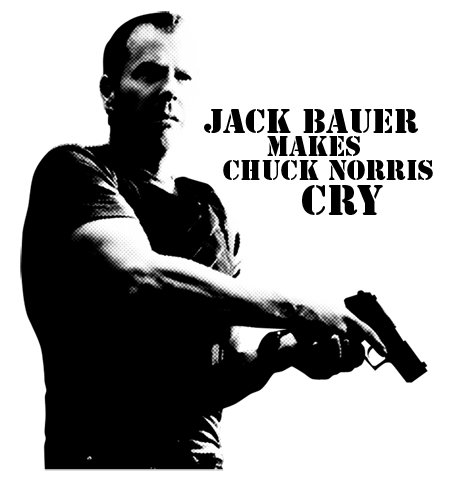
When brought to bear on Jack Bauer, a modern symbol of ‘manhood’ (pictured above as striking fear into the heart of Chuck Norris), Freud’s writings subvert that rugged ideal into something more controversial.
As a character on the TV show 24, Bauer’s character is known for his psychotic defense of America, which manifests in violent outbursts. Freud might attribute this ‘masculine’ quality to a fear of castration; in order to feel sexually safe, Bauer must act out – striking at authority, which represents that paternal figure, that young boys can come to see as a rival and threat.
Freud might also have argued that Bauer’s character’s masculinity has sadistic roots; he takes pleasure in the pain of others, and so seeks a job, and excuses to act out his neurosis.
A symbol, Bauer – as an actor’s – masculinity is rooted in the concept of men as violent creatures. This violence can arise to satisfy both the public’s need for their own repressions to be dominated (masochism), and men’s need to feel strong against the threat of female-dominance/castration.
At the heart of it, Freud would argue for the subversions of all that modern audiences take Bauer to represent. Today, such assertions seem ridiculous, and not a little bit BS-y. Their value comes from the innovation at the time, and the new perspective it lent to the Victorian Era.


No comments:
Post a Comment