Friday, December 4, 2009

A Wizard

Historically, the 1939 film The Wizard of Oz, has been interpreted to be a coming-of-age story about realizing the value of home. Dorothy’s “There’s no place like home” line is both famous and – seemingly – definitive. However, in his 2002 book “The Wizard of Oz”, Rushdie challenges this, saying the tale is one of exile, realizing the inadequacy of adults, and that the ending is a betrayal/Hollywood cop-out. In viewing this video of Indian children singing “In the Merry Old Land of Oz”, Rushdie might have interpreted the clip to be a continued parallel between Bollywood and The Wizard of Oz’s style, the children’s longing to escape home, and a projection of the children eventually realizing the inadequacy of their situation.

According to Rushdie, the Wizard of Oz “fit[s] into what was…and remains today, one of the mainstreams of ‘Bollywood’ film production”, but with tighter production values. This explains why children in India today would still be engrossed in perpetuating a film created 70 years ago. It fits better into Indian culture.

Rushdie says the Wizard of Oz “shows that imagination can become reality, that there is no such place as home or rather that the only home is one we make ourselves.” Given that the children singing the song all – like Rushdie – originate from overcrowded India. In view of the large numbers of Indian immigration to the US, and Indian success in the US, the desire of the children to come to a land where “they [can] laugh the day away” (such as the US) seems to mirror the desire to go to Oz.

The children in the youtube video are being made to sing the song by adults, because of their belief that adults are powerful and frightening figures. This mirrors Rushdie fear of his father, and Dorothy’s of the wizard. Like them, “when the curtain fell away and …offspring discover the truth about adult humbug it was easy to think, as she did, that wizard [parents] are very bad indeed”. These children forced to sing a song will eventually realize the ridiculousness of adult authority.

Rushdie rejects the end of the “Wizard of Oz” as Hollywood drivel. The children in the video sing with vague feelings that the reason they do so is their own desire to escape, the film’s link to Bollywood, and the one day they must reveal their instructors as frauds.

Smile


One of the most famous paintings in the world, the Mona Lisa by Leonardo da Vinci, has undergone much scrutiny, mimicry, etc in the centuries since it was originally created. In 1919, the famous DADAist Marcel Duchamp painted his own version, added a cheap mustache, and titled it “Elle a chaud au cul”, or, “she has a hot ass”. Since then, Salvador Dali, Andy Warhol, and what seems like half-the-internet have reinterpreted the mysterious lady. In the picture of the Mona Lisa as a character on the Simpsons, we see post-modernism as Frederic Jameson christens “post modernism”, that is it depicts “the effacement… of the older (essentially high-modernist) frontier between high culture and so-called mass or commercial culture, and the emergence of new kinds of texts infused with the forms, categories, and contents of that very culture industry so passionately denounced by all the ideologues of the modern”.

The Simpsons ‘Mona Lisa’ does not make the artful, modernist point found in either Duchamp’s or Dali’s Dadaism/Surrealism. According to Jameson, “postmodernism…[is] fascinated precisely by this whole “degraded” landscape of schlock and kitsch, of TV series”, and this interpretation is clearly revealing in the popular culture of the Simpsons art style. Even the name “Mona Lisa”, parallels the name of the Lisa Simpson, the show’s main female lead. No point is being made; the reference is created only for the mild, kitsch amusement of connecting one thing that contemporary viewers will appreciate with an absurd – thus amusing – subject.

According to Jameson, the Simpsons Mona Lisa is postmodern because it fills the capitalist need that post modernism thrives in. Jameson claims that postmodernism occurs from the fact that in today’s world , “aesthetic production … has become integrated into commodity production”: therefore, this Mona Lisa exists to fill the need for the short-term clever/pretty idea that can consumed and forgotten. It was quick, easy, and cheap to produce. So easy, in fact, that anyone could do it. On the Simpson’s website, browsers are given the option to create a character that looks like them. This Mona Lisa was formed out of a need to produce cheaply a maximum reward towards capitalist gains.

The value of the Simpson’s Mona Lisa is that it creates wealth. Jameson argues that the “truth of postmodernism, …is multinational capitalism.” With 449 episodes that have broadcast world-wide, the Simpsons stands for as an internationally franchise. There is a movie, merchandize, fans, etc. The creation of this new Mona Lisa merely glorifies the capitalist power of the original show.

Though its facination with pop culture, integration of aesthetics and production, and capitalist ends, the Simpson’s depiction of the Mona Lisa places the famous painting in its rightful place amidst post modern culture; as something to gain shallow enjoyment from before moving on to the next, money-making thing.

Thursday, November 5, 2009

Freudian


Most everyone in modern, Western society is familiar with the works of neurologist Sigmund Freud. His terminologies, and even name, are commonplace. Yet there is still something of a surprise in reading his works and seeing how very…well, Freudian they really are. Everything has its roots in childhood; the unconscious is a force to be reckoned with, and such seemingly simple concepts as ‘masculinity’ aren’t simple at all.

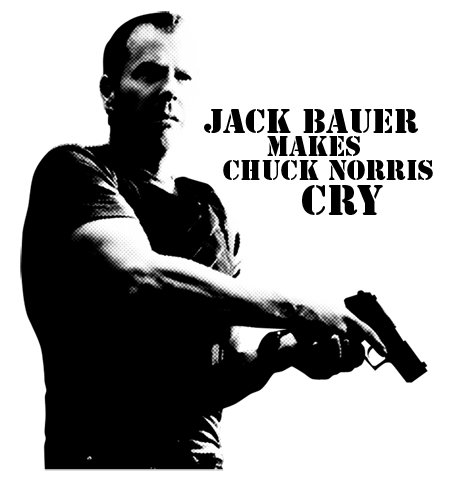
When brought to bear on Jack Bauer, a modern symbol of ‘manhood’ (pictured above as striking fear into the heart of Chuck Norris), Freud’s writings subvert that rugged ideal into something more controversial.

As a character on the TV show 24, Bauer’s character is known for his psychotic defense of America, which manifests in violent outbursts. Freud might attribute this ‘masculine’ quality to a fear of castration; in order to feel sexually safe, Bauer must act out – striking at authority, which represents that paternal figure, that young boys can come to see as a rival and threat.

Freud might also have argued that Bauer’s character’s masculinity has sadistic roots; he takes pleasure in the pain of others, and so seeks a job, and excuses to act out his neurosis.

A symbol, Bauer – as an actor’s – masculinity is rooted in the concept of men as violent creatures. This violence can arise to satisfy both the public’s need for their own repressions to be dominated (masochism), and men’s need to feel strong against the threat of female-dominance/castration.

At the heart of it, Freud would argue for the subversions of all that modern audiences take Bauer to represent. Today, such assertions seem ridiculous, and not a little bit BS-y. Their value comes from the innovation at the time, and the new perspective it lent to the Victorian Era.


Haunting

The PBS documentary, Ghosts of Rwanda, depicts a series of events that philosopher/sociologist Jurgen Habermas might call a ‘failure of the public sphere’. The film recounts the events of the 1994 genocide in Rwanda, which was mostly ignored/misconstrued internationally, and whose own media systems were used to fuel internal hatreds. Because the significance of the struggle was both local and global, Rwanda can be said to have been operating in two public spheres; the first of the bourgeois within the country, and the second of the worldwide community.

The sphere within the country was likely a pre-modern (or even post-modern) public sphere. That is, the dominant class of the Hutu had control media to such an extent they were nearly like princes of the past – who could distribute information that controlled both private and public lives – or corporations, which monopolize public opinion with their own views and pay only token respect to the private concerns of the unified state. The ‘sphere’ then failed in its duty of having “access guaranteed to all citizens” (Habermas); it was allowed to be used entirely as a political tool. Print Media (subsidized by government controlled papers) began the hate speech, which later monopolized all corners of the public sphere, especially radio. In such ways, was the public sphere subverted from a tool to “transmit the needs of …society to the state, in order…to transform political into "rational" authority” (Habermas), into a tool for mass murder.

The failure of the international community’s public sphere was subtler. Since the United Nations/Global leadership might be thought of as a “Social Welfare State Mass Democracy” it suffered the “refeudalization of the public sphere” which goes along with that. That is, since the world wide community is so large, and the private interests within it so massive (in this case, various countries/organizations), they overpower the smaller and more personal public sphere of individuals and small interest groups. Because a worldwide public sphere is therefore bureaucratic and unwieldy, it was able to ignore the genocide or misrepresent it because that is what its most prevalent ‘private’ groups wanted. The media outlets were censored or in the dark, because at that scale, they naturally “strive for political compromise with the state and each other, excluding the public sphere whenever possible” (Habermas). Therefore, the failure here was of the public sphere exceeding the size where a public sphere is ‘public’ at all.

Ghosts of Rwanda, then, is an attempt to reopen conversation about the public sphere and its necessity in our time. It seeks to make viewers question “why didn’t we know/do?” The curiosity of it, however, is that it too is a product of a mainstream media whose nature does not allow it to be entirely ‘public’, and so even its truths must be analyzed for hidden facts.

Friday, October 30, 2009

Law and Order

Law and Order is yet another of previously mentioned mainstream broadcasts that are sure to make professionals in its featured fields wince every once in a while. On air since the 1990’s, it has proliferated for decades despite this, because it disseminates (and creates) “dominant ideologies”. Law and Justice may not be the fast-paced, high-stakes game that the show portrays them as, but when its producers decided to ‘encode’ it with meaning, those are the values they perceived as having truth for themselves, their wallets, and the public eye. Since most people don’t actually work in the jobs portrayed on the show, the romanticized dissemination of those ‘codes’ merely taps into the culture’s ‘preferred’ interpretation. Law and order then affects its audience’s ideology by attempting to achieve ‘a perfectly transparent communication’ with its audiences: that is, it seeks to encode signs/connotations that is so widely accepted that viewers interpretations will perfectly match the meanings intended. When audiences agree to this, their ideology is accepted to be that of the ‘dominant hegemonic position’.

Not all people can decode – that is, ‘read’ the connotations into meaning – so “perfectly” however. Sometimes life experience creates for disagreements with widely accepted points of view. Audiences that can then understand the intended codes but seek to mold them into their own experiences can be said to have “negotiated readings” of the show. This will create for some conflicts. For example, if a viewer has had one or two experiences in court, and notes that the way something is being treated on the show is not exactly true to life, but otherwise think the show fairly accurate, they will have to accept the contradiction and move on.

Lastly, there are those that can interpret what is meant, but whose global beliefs run contrary. They understand what is being connotated, but their own ideology rejects it. Someone with an alternate experience of the law, and the perceptions expressed on the show will reformat what the show gives them to place it in a new context. This would be an ‘oppositional’ or ‘counter-hegemonic’ reading.

In the strange event that someone – perhaps from another culture – understood the intended meaning though a different series of codes than the producers used, this would then be an ‘aberrant decoding’.

The dominant order, then, runs more contrary to the specifics or reality, and the oppositional might be supposed to be too obscure for most to be aware of. It might then be supposed that the ‘negotional’ code is how most read, and that in disseminating its material, Law and Order continues to uphold the current hegemonic preferences, without worrying about them too strictly, as producers must be aware of audience interpretation.

Ugly

War is ugly, and war photography doesn’t seek to deny this. That very parable, present in CNN’s “Iraq Soldier” (pictured above), is part and parcel of a “myth” as Roland Barthes’ Myth Today would call it. Barthes’ myths are “depoliticized speech”, that is “the function of myth[s] …[are] to empty reality”; basically, they are systems which turns signs into signifiers, and in so doing, naturalizes concepts that society as a whole – or at least “bourgeois” society – embraces. On the surface, the picture of the soldier has its denoted, connoted, (and potentially even linguistic) messages. But if those ‘signifiers’ are then turned into signs, the ‘myth’ of the photo is born. That is, those things we look at and accept as being the unquestionable way of things.

Prominently, there are seven features to a myth: inoculation, history, identification, tautology, neither-norism, the quantification of quality, and the statement of fact. By exploring how the photo embodies all of these, a basic understanding of the image’s mythology appears.

First, the photo inoculates, that is, it “admit[s]… [an] accidental evil … the better to conceal …[a] principal evil.” Here, it is immediately acknowledged that ‘war is ugly’: buildings crumble, the gun menaces, and violence hangs in the air. These brutal elements pay surface respect and in doing so, ‘naturalize’ the image. Once viewers accept them, they never need question the ‘principle’ evil of “why war”?

Then, there is the matter of history. Barthes claims that “myth is constituted by the loss of the historical quality of things: in it, things lose the memory that they once were made.” The photo asks that we accept the solider. It does not ask for our judgment or politics. It lives very much in the now, in that there is no way it can conceive of a time before or after the snapshot.

The third principle, ‘identification’ is a myth’s ability to place everyone inside it (or give it a place around it), and allow everyone to associate. The American soldier is a warrior, a freedom fighter, etc. This photo gets deeply inside that myth. Indeed, many American soldiers work desk jobs, or have positions outside of the Middle East, but the mythology places them in danger, there.

The matter of ‘tautology’ (or, a “propositional formula that is true under any possible valuation”) is simple in naturalizing images. Since this photo depicts a soldier as he is (or, must have been at some point in the past), it can be accepted to be the way it is because it is. The reality of an Iraq soldier as photographed must be accepted, because it is reality. All alternative arguments are made impossible.

Neither-Norism in myth “consists in stating two opposites and balancing the one by the other so as to reject them both.” In the instance of the CNN picture, the viewer first looks at the solider, and says – perhaps – “this solider is violent, I reject his presence in Iraq as overbearing and an unnecessary use of force!” However, in looking at the destruction around the soldier, and knowing the alternative, says also “Al-Qaida is a terrible organization, and should be done away with: I protest allowing such things to proliferate!” In rejecting both possibilities proffered by the picture, the viewer then is free to accept the image as it is, thus naturalizing it.

Myth’s “quantification of quality” principle seeks to “economize intelligence”. In this image, the complex nature of the fight in Iraq, the multiplicities of jobs, problems, and options is reduced to the quality of a single picture so it can be easily comprehended and understood.

Lastly, the ‘myth’ of the CNN image can be understood as ‘myth’ because it contains a ‘statement of fact’. Myths tend to become proverbs, which tend to get adopted as common sense, so the statement “war is ugly” once more can be seen in the image, and as a part of its myth. It is natural for us to expect to see this accepted fact in a photo of war, and further leads to the overall cultural acceptance of it.

In the end, the myth of the CNN image may hold that “right” or “bourgeois” bent which Barthes claims is most common in myth, but is not actually a political statement. Because myth is not political. It seeks to create a reality that its audience feels is reality, whether that is the whole of the matter or not.

Thursday, October 15, 2009

Morally Gray

Gray: the color that predominates the poster for the Soprano’s final episodes calls to mind overcast streets and hazy morals. According to Roland Barthes’ essay on The Rhetoric of the Image, that first, predominant impression is one of denotation. Denotation, the last of the three things he claims analyzed photographs provide: “a linguistic message, a coded iconic message, and a noncoded iconic message.” Universally, all can observe the drab coloration, the violence of the red lettering, the serious (perhaps even menacing) expression of the man in the dark suite, the choppy waters, and – nearly universally recognized – far-off statue of liberty. In his essay, Barthes claimed “if the image contains signs, we can be sure that in advertising these signs are fully formed, with a view to optimum reading: the advertising image is frank, or at least emphatic.” Since the Soprano's poster is an ad, viewers can be sure that the composition means something. Therefore, we move to the connotative value of the image, or, the social meanings we can gather by analyzing the signs of the picture. Here is where the initial grayness of the picture can come to mean a grayness of morality/purpose. The statue of liberty – which represents America, justice, immigration and freedom – is distant, giving the sensation that perhaps law is also distance in this colorless world. The other aspect of Ellis Island can tie into the man in the foreground as well; his features suggest an Italian past and immigration. The black suite can be read to mean he has done well for himself. Combining his implied past, clothes and culture brings viewers to the stereotype of mobsterness. Connotatively, then, the picture seems to produce a vibe of lawlessness, crime, foreigner intrusion, and uncertain morals. These, however, remain uncertain, and it is the text that allows the viewer to anchor this multiplicity of options.

Barthes argues that the dominant function of the picture’s linguistic message is anchorage, since “all images are polysemous; they imply, underlying their signifies, a ‘floating chain’ of signified, the reader is able to choose some and ignore others. …Polysemy poses a question of meaning…”. Here he is saying that since there are so many ways to interpret signs, text is needed to let us know what specifically the signs want you to believe. For example, one meaning of the statue of liberty is tourism. However, the harsh, black and red text doesn’t seem to play to the idea of happy consumerism, so the code for tourism is discounted. The actual message of the text “The Final Episodes – April 8, 9pm. Made in America” serves as an anchor as well. The choice of the more sinister “final” as opposed to the buoyant “finale” adds an element of potential violence. “Made in America” parodies the omnipresent “made in china” found stamped on most American toys and consumer items. It implies a unique American experience, but it also acknowledges that we are in America – which is something that most American shows wouldn’t need to do. The presence of the easily recognizable statue should be enough to tell audiences that the location is New York, one of the most identifiable U.S. cities, so by repeating the location in the text, the overcompensation makes us additionally aware of the unmentioned foreignness. These then are Italian-Americans. They are in the U.S. now, but they weren’t always. The bloody red of this last font calls to mind gunshot wounds piercing an otherwise dark setting. The linguistic message of the picture brings all the elements together, uniting what promises to be a drama of morals and laws with action and the exoticism of recent immigrants.